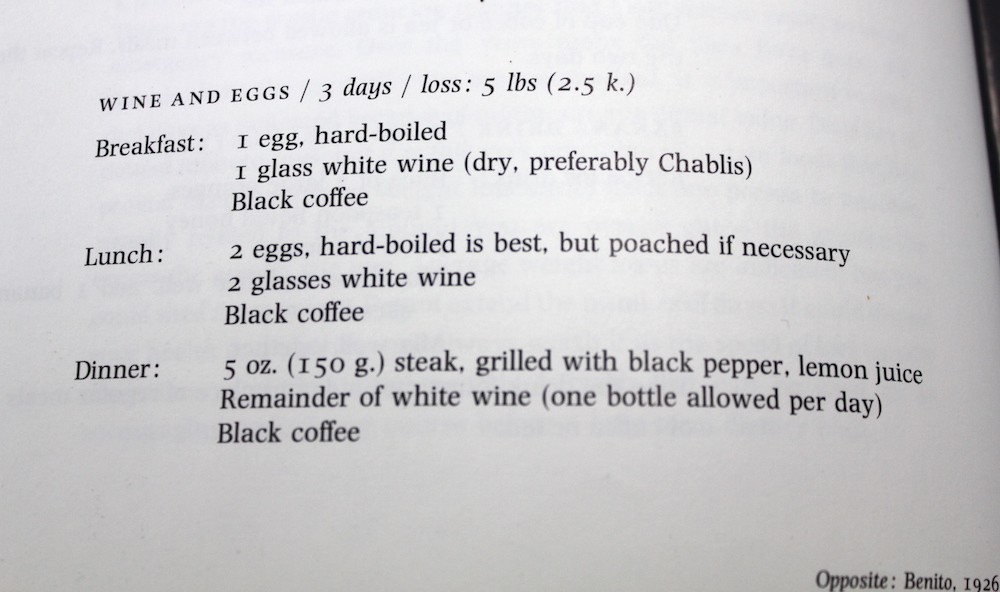
Off the back of our recent post, a reader (thank you, Anna!) sent us the five things she keeps being told to take, drink or reorganise her life around, and asked a very valid question: how do you tell a fad from a hack? Spotting nonsense disguised as guidance is definitely not a new concept; we’ve yo-yoed through some weird and wonderful trends spanning Vogue’s 1977 Wine and Eggs diet, belts that jiggled the fat off you in the 1960s (and, judging by the lawsuits, were still going strong in 2009), radium water in the 1920s, and a thirty-year stretch in which the best-selling contraceptive for American women was a household disinfectant. I love this stuff, so the full lowdown is at the bottom.
Atkins diet but with a hangover? Maybe?
Being in, and maintaining, good health is actually rather boring. At its most basic level, good health is getting the fundamental building blocks right and supplements should be seen as the very last addition. Imagine building a house you want to be strong and durable and rather proud of. Yes, choosing curtains is objectively the more fun part. But without foundations, floors, walls and windows, the curtains are pretty much just decorating a field.
During my career as an athlete, one of my coaches refused to let me take any supplements. His rationale was, there is absolutely no point chasing the 0.5% gain from caffeine, protein powder, beetroot shots if you’re not completely getting the 99.5% right. I completely agree with this. Learning what your body needs, sleeping lots, having a varied diet, exercising, being outdoors and drinking water will ultimately make a MUCH bigger difference than trying to mitigate no sleep, no exercise and a diet that doesn’t fuel you with two capsules and a green powder that tastes suspiciously like a pond.
Anna’s five:
Cortisol detox cocktail
A morning drink of fruit juice, coconut water, sea salt and magnesium, said to flush excess cortisol from your bloodstream and because that’s not enough, simultaneously reduce anxiety, fatigue, brain fog and belly fat.
What the evidence shows: There is 0 evidence that a salty juice clears cortisol. Your body already does this through normal metabolism, mainly via the liver and kidneys, and unless you have a medical condition affecting those organs, it doesn’t need a detox juice to help. And, for the 100th time, cortisol does not simply cause belly fat. URGH. Chronic cortisol excess can produce a specific pattern of weight gain and fat redistribution, including around the stomach, but that is a medical condition, not a wellness claim.
Verdict: Skip. Unless you just like the juice, in which case enjoy, and be aware that you are just drinking a fruit juice.
Probiotics
Capsules said to boost the diversity of your gut bacteria, help digestion and bloating, and support your immune system.
What the evidence shows: Probiotics strains are very unique! Different strains can have completely different effects, so you can’t take the evidence for one and copy-paste it onto another. Some individual strains do have good evidence for particular conditions. but there is no strong evidence that taking a random probiotic capsule will fix your digestion (sadly!). Fermented foods are a great option as there’s evidence emerging that foods containing live microorganisms, such as yoghurt, kefir and kimchi, can reduce inflammation and improve gut health.
Verdict: Don’t rush out and buy a probiotic because the marketing says it’ll improve your gut. Regularly eating fermented foods if you enjoy them? Absolutely! And, if you need a probiotic capsule, hunt down the specific strain you need, and it’ll be much more effective.

Skip the cortisol juice, go for fermented foods
Collagen
Collagen is a structural protein which we make less of as we age, with the effects being seen in our skin - hence the capsules, creams, drinks, gummies and coffees (?) promising firmer skin, fewer wrinkles, slower ageing and less creaky joints.
What the evidence shows: Murky. Some reviews and randomised trials have found oral collagen improves skin hydration and elasticity. But, a 2025 meta-analysis that sorted studies by funding source and quality found the benefits disappeared in the independently funded, higher-quality ones. Whilst this isn’t quite a blanket ‘collagen is nonsense’, I wouldn’t be spending £40 on a tub because someone with gorgeous skin told me it reverses ageing. The evidence for hair and nails is even murkier: some early studies, certainly nothing that should be promising you Rapunzel hair. As for collagen creams: collagen is a large molecule and as such it can’t pass through your skin’s outer barrier and slot itself into your dermis. A collagen moisturiser will hydrate and sit on the surface like any other moisturiser, which is fine, but the collagen itself is not going in.
Verdict: Not really worth it. If you already eat plenty of protein and want to cover the bases, fine. Otherwise, spend the money on a good SPF, which has far stronger evidence for preventing premature ageing, or a science-backed retinoid.
Cycle syncing exercise
This in particular needs nuance. A whole host of people now claim that training hard in the follicular phase and easing off in the luteal phase builds more strength and lowers injury risk, and a fast-growing industry will gladly prescribe entire training plans anchored to cycle phases.
What the evidence shows: As with a lot of women’s health, no strong evidence either way. A 2023 umbrella review found little robust support for the concept that cycle phase noticeably affects strength performance or longer-term adaptation, and flagged that many of the underlying studies were poor at confirming which phase participants were even in. Essentially, the evidence is shaky in both directions. That doesn’t make how you feel wrong. For some women (I’m one of them) symptoms can be debilitating, which is exactly why a one-size-(phase)-fits-all prescription is unhelpful. If you’re in pain, adjusting your training to how you feel is entirely reasonable. Equally, prescribing types of training based on phase is challenging – not all women experience energy shifts throughout their phases in the same way.
Verdict: Completely your call. If you want to stick to your programme regardless of phase, do it! If you feel sluggish and sore, do what feels good. This is not something anyone can apply to you from a template without knowing you, and you’re the only one who can make a judgement call on how you feel.

Loading up on iron around your period
Taking more iron while you’re bleeding sounds logical: replace what’s lost, keep deficiency and fatigue at bay. Not so fast...
What the evidence shows: Iron stores rebuild slowly over weeks of steady intake, not quickly replaced in the few days during your period. There’s obviously strong evidence that regular daily supplementation helps women who are confirmed deficient - lowering anaemia risk and improving fatigue and exercise capacity but there’s zero evidence a period-only schedule does the same. Frustratingly, NHS thresholds vary by region and often only flag women once they’re already anaemic, and around a third of women are thought to be iron deficient.
Verdict: Skip the period-only version. If you’re deficient, treat it properly rather than cramming a month’s iron into four days. Food like red meat, beans, lentils, leafy greens and fortified foods can all help maintain levels. If you’re unusually tired, breathless, pale, getting headaches or have heavy periods, get your iron status checked!
If you’ve got a question, or want to join our beta testers in finding out how your hormones link to your health patterns, email us at info@nurihealth.ai!
As promised, some fun examples of what NOT to do:

A real medley of bright ideas...
Disinfectant as birth control (1930s to 60s)
For roughly thirty years the best-selling contraceptive for American women was Lysol – the disinfectant. Advertising actual contraception was illegal, so it was subtly sold as ‘feminine hygiene’ and women were encouraged to douche with it after sex. It didn’t work (failure rate over 50%), and the pre-1953 formula was caustic enough to cause serious burns, with poisonings and deaths on record. It stayed market leader until the pill arrived…
Vogue’s Wine and Eggs diet (1977)
Published by Vogue in the Vogue Body and Beauty Book where it was promising 5lb lost in three days. Breakfast: one hard-boiled egg, a glass of white wine (note, Chablis preferred), black coffee. Lunch: two eggs, two glasses, coffee. Dinner: a small steak, coffee, and the rest of the bottle. Atkins, but with a hangover?
Fat-jiggling belt machines (1950s to 60s)
Stand on a platform, loop a wide belt round your bum or belly, and let a motor shake you. The founder pitch was ‘spot reduction without effort’. The result was a wobble and I’m a big fan of the visual. Comically, in 2009, marketers of modern vibration machines were fined millions for overstating fitness claims, so the concept proved hard to shake off. Sorry – I saw my chance and took it.
Cellulite (1933 / 1968)
Cellulite is just ordinary skin texture that most women have. It became a ‘problem’ to remove in a 1933 French magazine and reached America via a 1968 Vogue piece headlined ‘Cellulite: The Fat You Could Not Lose Before.’ Recommended cures included dieting, standing ‘correctly’ and rolling a pin over your own thighs... The treatment industry is still cashing in on that manufactured anxiety, which makes it a more depressing version of the Valentine’s Day origin story.
Radium water (1920s to 30s)
Radioactivity was briefly sold as an energy booster, in tonics, toothpaste and chocolate (yum). The poster case is Radithor, radioactive water in little bottles as a cure-all. A wealthy American, Eben Byers, drank around 1,400 of them. It dissolved his bones, his jaw was removed, and he was buried in a lead-lined coffin because his body was still radioactive. Amazingly, the fad collapsed only after he died.
■ Founding members · Limited places
For the first time, see how your hormones and metabolism respond to food, and get nutrition built for your body, not an average one.
Claim my place →