Over the past couple of years, hormones and cycle phases have become famous - not necessarily known, exactly, but certainly famous. Cortisol is now a celebrity with its own (puffy) face, its own villain arc and its own redemption products, while luteal has now been recast as every woman’s ugly stepsister. And somewhere between the hormone-balancing seed cycling (?) and the influencer explaining that your Tuesday exhaustion is definitely your luteal phase and solvable by exclusively drinking her miracle-cure-lukewarm-broth, an entire industry has worked out that women’s hormones are the perfect product: mysterious enough that nobody questions the claims, universal enough that the market is half the population. Every symptom a woman experiences can now be confidently attributed to her hormones, usually by someone with a discount code and sadly often with very little evidence behind the claims - such is the magic of the wellness bucket in an industry with little evidence and research.

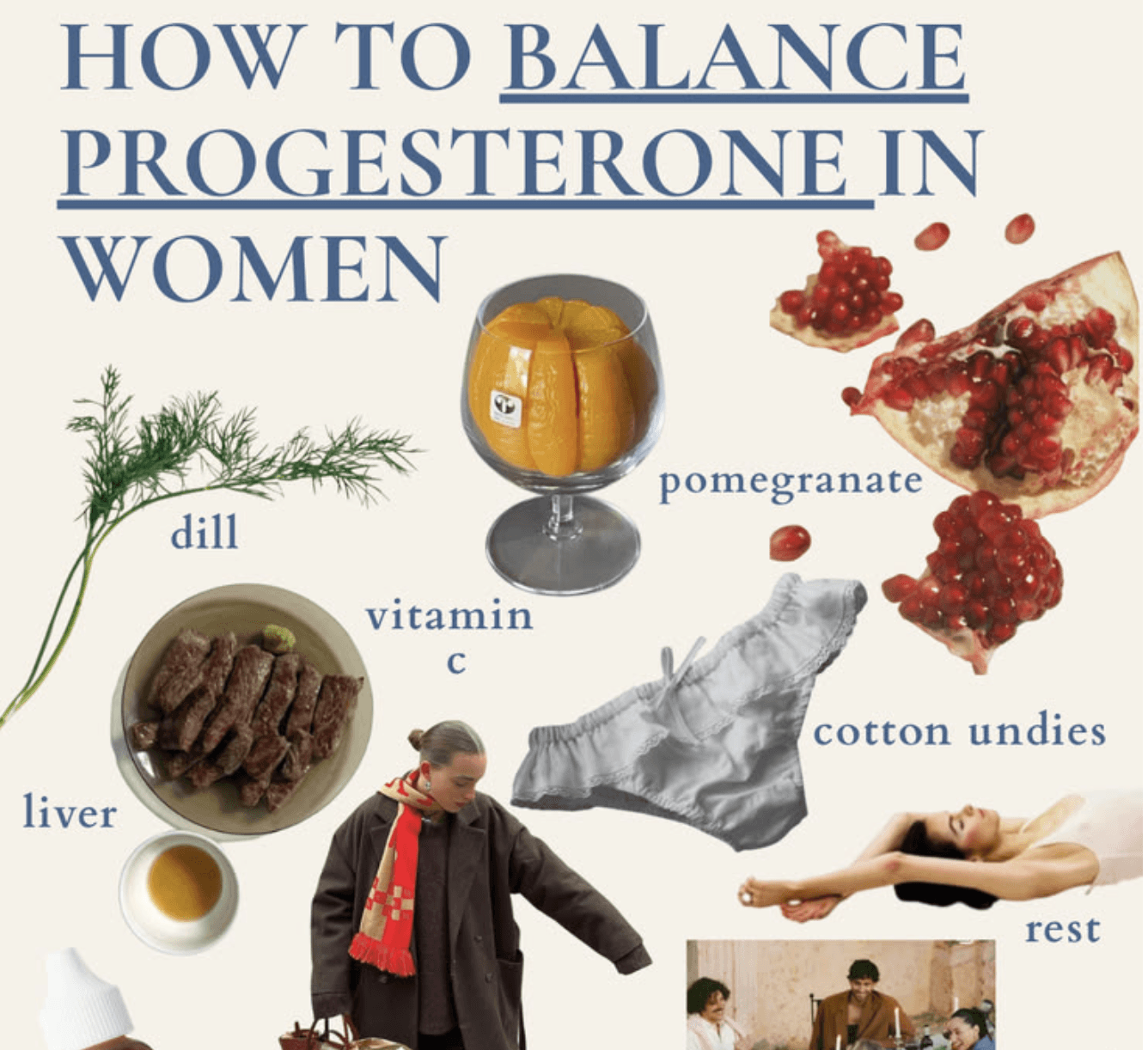
If nothing else, I can agree that sardines make a good snack. Jury's out on if cotton underwear really does in fact balance progesterone.
Coining hormones
In 1849, a German scientist named Arnold Berthold did something strange (and unethical) to six roosters. He removed the testes from four of them, then re-implanted the organs into the abdomens of two, in entirely the wrong place, with no nerves attached. The birds with the transplants carried on crowing, strutting and picking fights as if nothing had happened. Berthold concluded that the testes must be releasing something into the blood that told the rest of the bird how to behave.
That something didn’t get a name until 1905, when a physiologist called Ernest Starling coined the word hormone, from the Greek for “to set in motion.”
I’m aware I just spent a paragraph on rooster testicles, and this might be a weird place for a women’s health tech CEO to start. But with good reason! Here’s the thing: an 1849 experiment on six distressed roosters is still, somehow, more scientifically rigorous than a considerable amount of the hormone content on your TikTok feed…
So, let’s unpack. What’s the deal with hormones?
What a hormone actually is
A hormone is simply a chemical messenger that’s made in one part of the body, released into the blood, and carried off to tell some distant tissue what to do. Your body runs on roughly fifty of them, produced by a scattered collection of glands (the pituitary, the one running half the show, is roughly the size of a pea) - that between them manage your growth, your metabolism, your sleep, your appetite, your stress response, your reproduction and your mood.
The scale and precision of this operation is absurd! Some hormones circulate at concentrations so low that finding one in your bloodstream is roughly equivalent to finding one particular person by searching every country on Earth. Your thyroid gets by on quantities of hormone measured in millionths of a gram, and if it drifts slightly in either direction there’s a good chance you will feel like a different person. This is, unsurprisingly, why hormones are so bloody hard to track both accurately and continuously.
Enter the marketers
If you’re female, there’s almost no chance you’re yet to encounter someone talking about “hormone balance,” which whilst sounds scientific, is completely ambiguous when you think about it. Your hormones aren’t synchronised swimmers holding a perfect pose; they’re meant to move - a hormone chart that stayed flat and “balanced” all month long would be a medical emergency, not a wellness goal. Which isn’t to say hormonal disruption isn’t a thing - chronic stress, under-fuelling, poor sleep and conditions like PMOS or thyroid dysfunction can all knock your hormonal rhythm off course. But when that happens, the fix is finding and addressing the root cause, not a £40 pack of gummies.
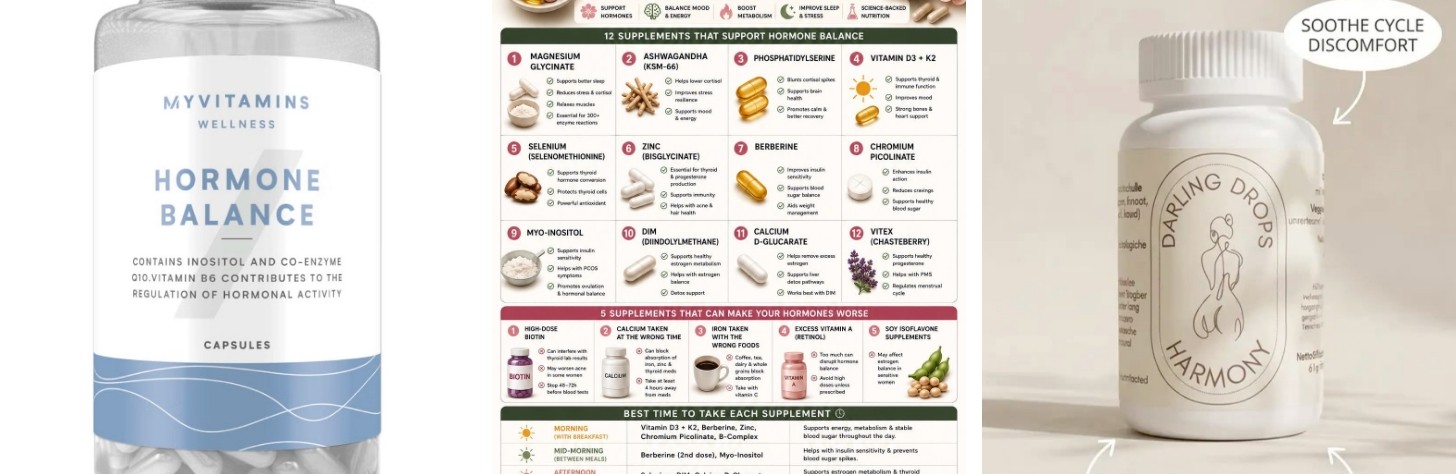
Maybe useful if the placebo effect works?
I have a lot of sympathy for cortisol, seen as the current scapegoat. Cortisol is blamed for belly fat, puffy faces, anxiety and general modern malaise, and the proposed fixes range from breathwork to £60 powders. HOWEVER, cortisol is also the hormone that wakes you up in the morning, mobilises energy when you exercise and keeps your blood pressure at a level compatible with being alive. You do not want zero cortisol. You want a cortisol rhythm that moves as it should, albeit a far less marketable sentence...
The GCSE hormone chart isn’t always to be trusted…
Nearly everything in this market - the apps, the syncing plans, the confident claims about what “day 21” means - is built on the textbook cycle we all learnt at school: 28 days, ovulation politely arriving on day fourteen. Tidy diagram, nice chart, easy to comprehend; but spoiler, not broadbrush applicable to all women.
Back in 2019 when researchers analysed over 600,000 real cycles from real women, only around 13% of cycles were actually 28 days long. Thirteen percent! The “standard” cycle turns out to be a minority, and ovulation is no better - day fourteen is the exception rather than the rule, with timing that varies enormously between perfectly healthy women. So really, if you match the standard cycle, you’re actually an outlier and the rest of us are boringly normal.
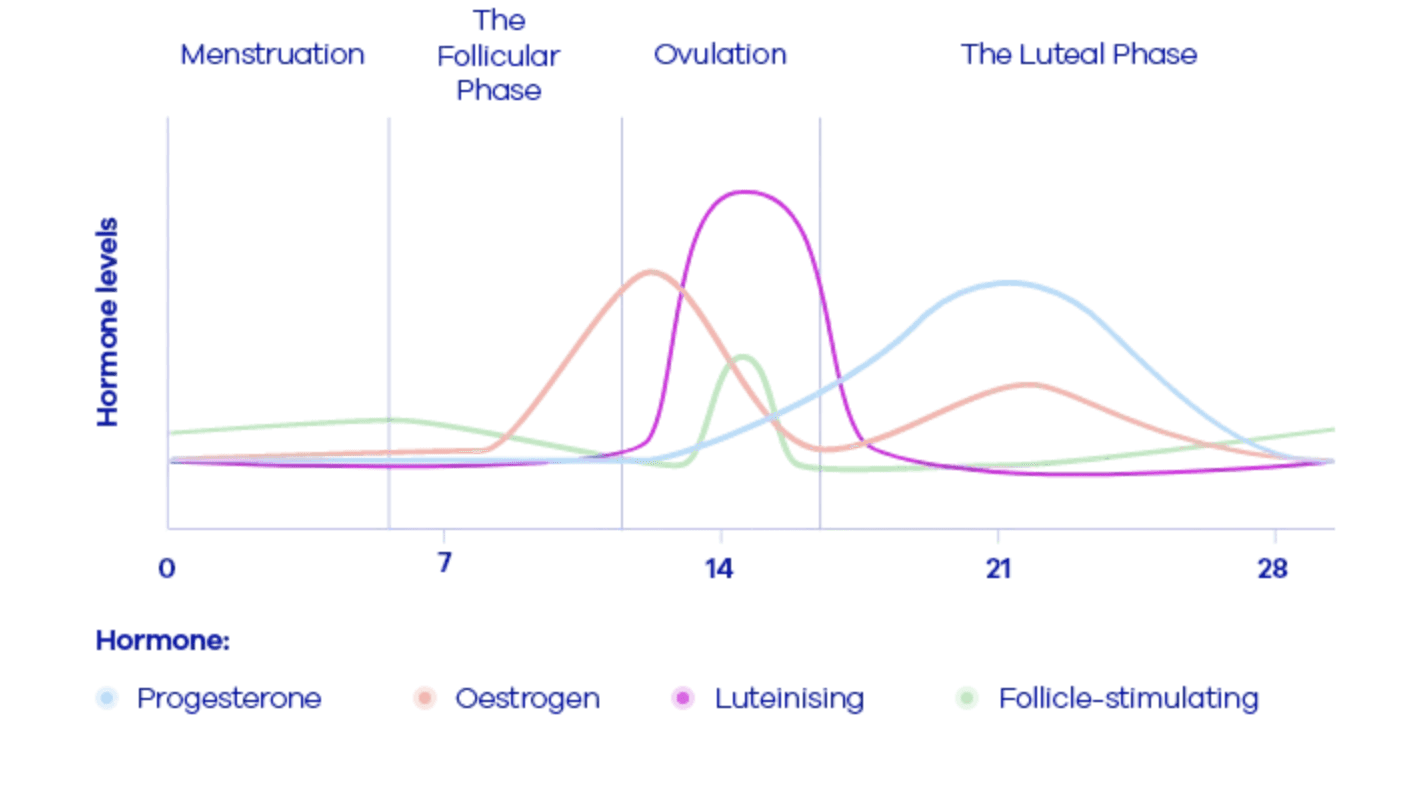
A very illustrative example chart!
So, what does this look like in day-to-day life?
Despite all the variability, fluctuation and individuality, your hormones aren’t invisible. They leave fingerprints all over data millions of us are already collecting without thinking about it. Whilst you can’t easily measure the hormones themselves, as a woman you can certainly see and feel their handiwork.
If, like me, your wearable’s HRV and recovery readings have ever been bizarrely out of whack with how you feel, there’s a decent chance it wasn’t overtraining or under-recovery - it was your cycle. After ovulation, as progesterone climbs, your core temperature rises slightly and your resting heart rate picks up by a few beats per minute, and naturally your recovery metrics drift. If you wear a ring or a watch to bed, your hormonal rhythm is in your data right now - it’s just that nothing you own has been taught to read it as a rhythm, so your device logs you entering the luteal phase as a bad night’s recovery instead.
Today, devices are largely built and validated on male-default data, so cyclical change gets treated as noise - and the second half of your cycle gets read as a decline. Warmer, faster heart rate, “worse” recovery - must be overtraining, stress, something wrong with you! Nothing is wrong with you. That’s a healthy cycle doing exactly what it’s supposed to do. It seems quite obvious that if we’re going to trust decoding our health with tech, we should really have cycle phases understood by said tech.
Given that monitoring and measuring hormones historically has been challenging, under-researched and misunderstood, most women have no idea what their own hormonal patterns, rhythms and symptoms typically look like. Today, even though we now have the technology to start building that understanding, from wearables, cycle data, blood work and symptoms, sadly the loudest voices in the room are still often just selling supplements as a quick fix. Don’t get me wrong, I love herbal tea as much as the next person, but personally I’d rather not rely exclusively on seeds and teas to tackle my health and instead enjoy them respectively with, and on, my morning yoghurt.
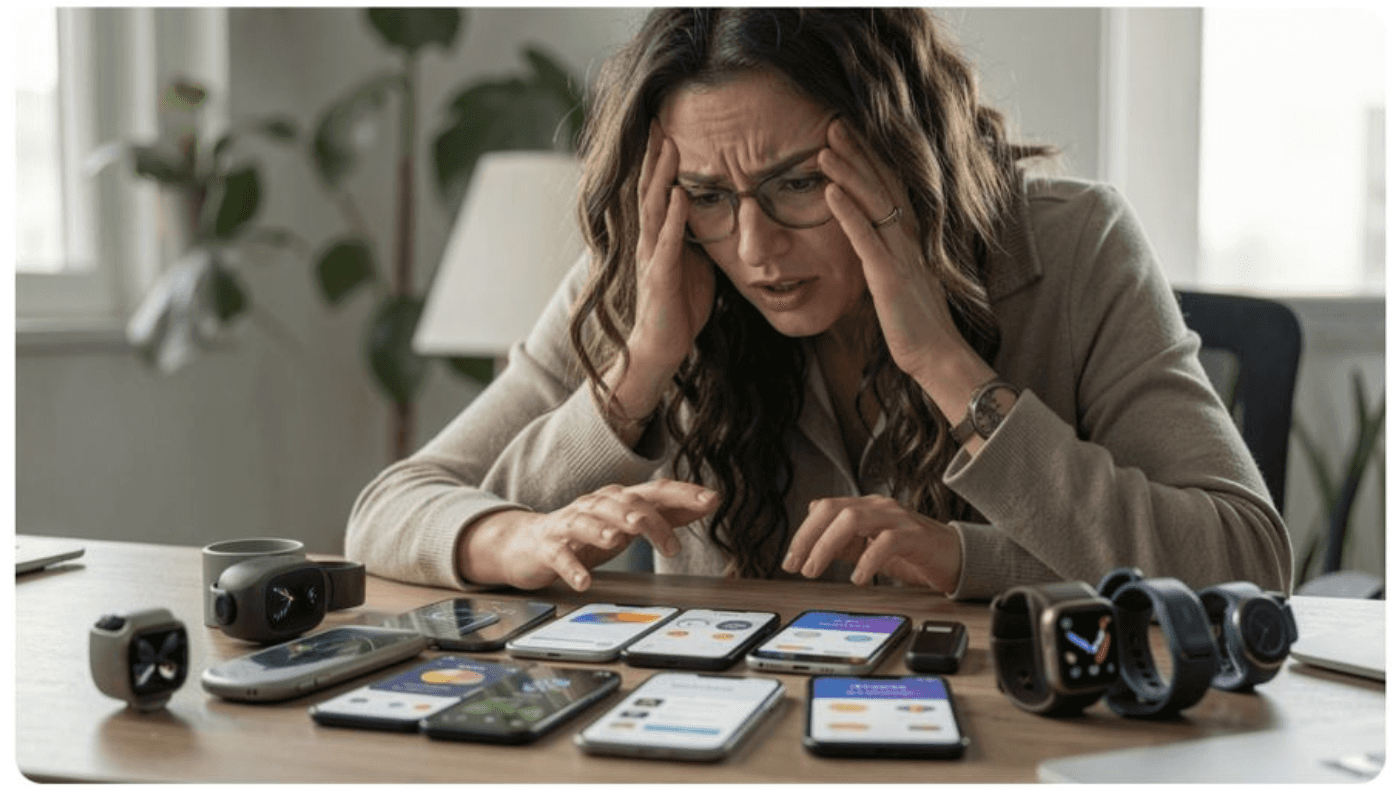
Naming and shaming no AI, but a certain AI tool made me this terrifying image to represent a woman tackling her health with today’s technology.
■ Founding members · Limited places
For the first time, see how your hormones and metabolism respond to food, and get nutrition built for your body, not an average one.
Claim my place →