
In the months leading up to the Tokyo Olympics I was asked to write an article about the physiology of female athletes. I spoke to Olympic champions, world champions, junior rowers, current athletes, retired athletes; women from different countries, different sports and different generations. I wanted to understand how they experienced their bodies and whether we were doing enough to help them perform at their best. For women who had taken such different paths through sport, their experiences were remarkably similar. Similarly to the real world outside of sport, I swiftly learnt that whilst the lack of understanding around female physiology wasn’t confined to one team, country or generation, all these women were asking for the same themes - more innovation and support to help them work with their bodies.
I found that article again a few weeks ago and I was struck by how little had changed. In the years since, we’ve made self-driving cars, robots are running marathons and we can inject ourselves skinny, yet we’re still asking many of the same questions about women’s health and the problem clearly hasn’t become obsolete. If anything, it feels more pressing now due to the sheer volume of data we’re able to generate on women’s bodies.

My initial entry article into the world of health, data, and understanding of female athlete health and performance. Thanks Tom Ransley for suggesting I write this piece!
During the time I was writing this article, one of my (now) co-founders was doing a very similar thing, albeit from the opposite side of the question. As I was writing and racing, she was interviewing women and compiling a growing list of problems that extended far beyond inaccurate predictions and empty promises of personalisation; and this list became both so extensive and frustrating that it propelled her to build something better. As she’s not one to do things by halves, she then became a leading researcher in the field, uncovered discoveries in women’s health data that had never before been collected or reported, and developed award-winning systems that helped women better understand and interpret their own health. What a woman.
For those who aren’t familiar with my story - I’ve spent the previous fifteen years racing as a professional athlete, with the last few years of my sporting career overlapping with my professional (real-world) career. I’ve always been headstrong, unflappable and reluctant to admit defeat, and I prided myself on being able to overcome anything – and until last summer my body was a well-behaved, highly functioning machine that I understood and spoke the same language as I did.
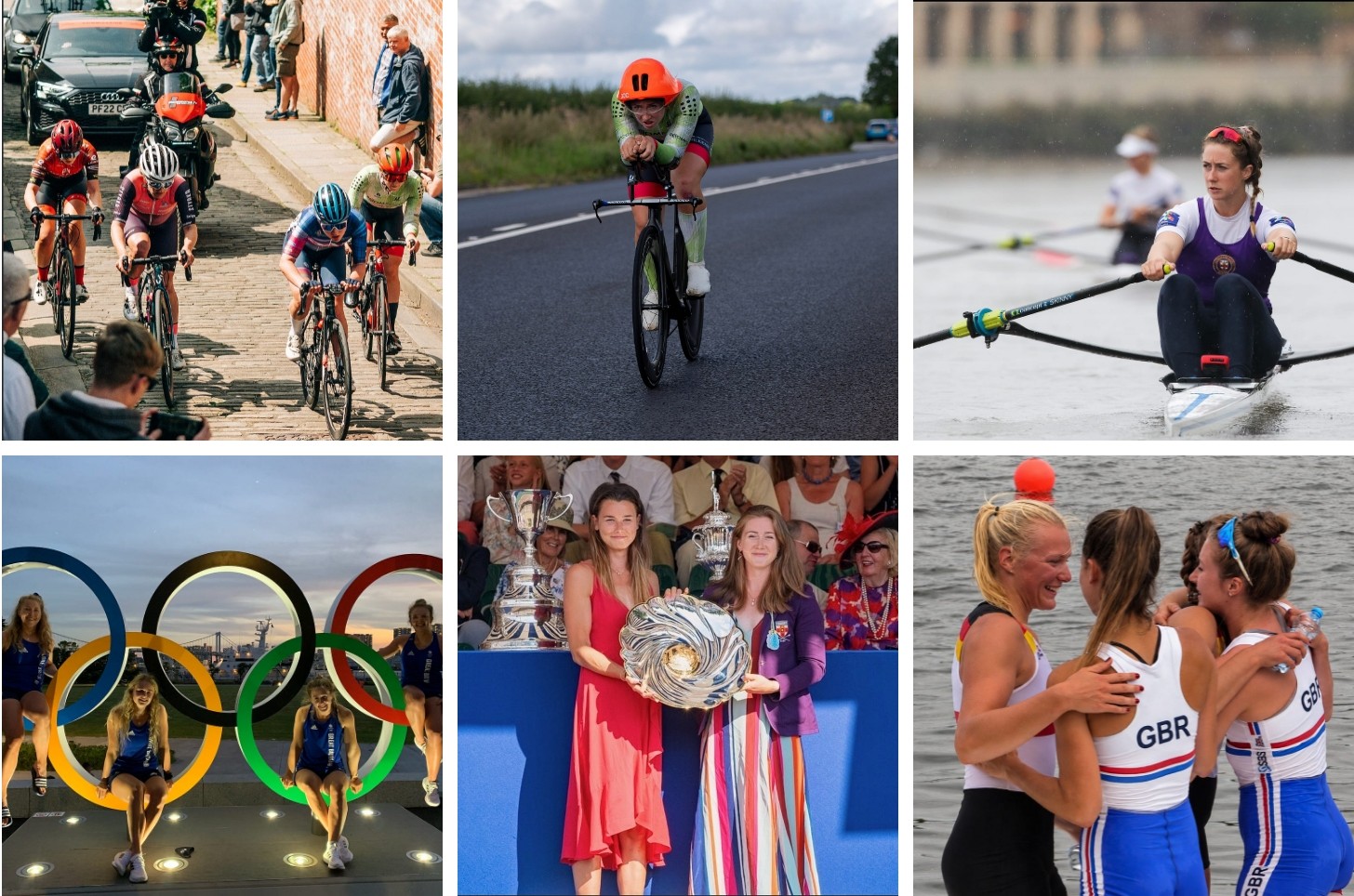
A handful of snapshots from my two sporting careers I've been lucky enough to experience.
Then quite suddenly, it felt like I was living in a completely alien body.
My mood whipsawed all over the place - I’d find myself in floods of tears; I developed anxiety; I felt permanently foggy, exhausted and strangely unlike myself. I’d wake up at four in the morning completely wired with stress. I gained close to ten kilograms in a matter of weeks, which, for someone who’s spent years thinking too much about body weight, was not an enjoyable experience. Then my periods, which had always been 100% consistent, went completely awol. I had absolutely no idea what was happening .
During this time, I was trying to pull together data, symptoms, and blood tests to uncover the cause and return to being my normal self. I went to appointments armed with my data to show how my body was changing. I sat there in the sweaty plastic chair to talk through my results and trends, hoping for guidance based on my body’s data and evidence. Instead, I was told things like, “you seem too highly strung.” That I “didn’t look unwell.” That perhaps I was simply expecting too much from my body. Apparently, the only advice was that women’s bodies change, and I should probably learn to accept it. [1]
I vehemently(!) disagree with the notion that women should willingly accept that elements of being a woman (can) suck. Sure, women’s bodies are complicated; they’re extremely variable; hormonal effects can be hard to understand. None of that is a reason to accept that half the population should spend years feeling confused by their own health. We shouldn’t accept products that weren’t designed with women in mind. We shouldn’t accept technology that ignores huge amounts of biological variability!
Back in 2021 I finished that original article by asking: “If we leave young athletes in the dark for so long [referring to their physiology], how can we expect them to grow and develop into their potential?” Five years later, I’d ask a slightly different question - “If millions of women are still left trying to piece together what’s happening inside their own bodies, why have we accepted that as normal?” The three of us definitely don’t think we should!
So, here goes! We’re building the product we all needed across the many different times in our lives. We’re building it for our sisters, our friends, our daughters and our mothers. We’re building it for all the woman who’ve wasted any fraction of their precious lives worried about their body and health and for all the women who’ve been stuck down a rabbit hole trying to understand what’s going on in their body!
I can’t wait to share this with the world and unveil what we’ve been squirrelled away working on. In the meantime, we’ll be sharing more of our journey and showcasing the incredible women we work with. For the women keen to follow closely, here’s our website: nuri health and we’ll be sharing our research, updates and findings along the way here on our Substack.

All good stuff in the name of progress + snacks
[1] To be clear - I don’t think it’s necessarily a blanket problem with clinicians. I think the way we combine healthcare and women’s health is under-researched, doesn’t represent real-life female bodies and is outdated compared to what we COULD be doing given the leaps and bounds in technology. Although, in full transparency, the specific female clinician I reference here was not falling short due to technological capabilities…
■ Founding members · Limited places
For the first time, see how your hormones and metabolism respond to food, and get nutrition built for your body, not an average one.
Claim my place →